Key points at a glance
- Pre-orders make production planning more precise: you know in advance how many cakes, loaves and baskets you need, and you have fewer leftovers in the evening.
- Choose one or two order channels you can handle reliably: phone, form, online shop or WhatsApp. Every channel needs a written confirmation.
- Set a lead time per product and offer fixed pick-up slots. Before Easter and Christmas there is an order deadline that you announce early.
- A deposit is common for custom cakes and large orders. For distance sales the right of withdrawal usually does not apply to perishable and made-to-order goods, but allergens must be visible before purchase.
- Make the offer visible: a dedicated “Pre-order” page on your website, an order link and posts on your Google profile, special opening hours and a notice in the shop.
This post is general information and does not replace legal or tax advice. Rules change and some differ between federal states: check the details with your chamber of commerce (WKO) or IHK, the competent authority or your tax adviser.
Why pre-orders pay off for bakeries and cafés
In a bakery, the success of a day is often decided the morning before: how much dough goes in, how many cakes get filled? Every pre-order takes some uncertainty out of that calculation. What is ordered is sold, not written off at closing time. How to plan with data beyond that and cut overproduction is covered in the guide on returns and food waste.
For customers, pre-ordering is convenient and reliable. They do not have to hope their favourite loaf is still there on Sunday, and they collect the birthday cake without waiting. The most popular items are:
- Cakes: birthdays, weddings, christenings, company parties, custom and photo cakes.
- Bread and rolls in larger quantities: for family breakfasts, clubs and offices.
- Breakfast baskets and brunch boxes: ready assembled, often with spreads, butter, juice or coffee.
- Platters and finger food: filled rolls, mini quiches, cake platters for parties and meetings.
- Seasonal and holiday bakes: Easter bread, Easter lamb cakes, carnival doughnuts, All Saints’ plaited loaves, stollen, Christmas biscuits.
Phone, form, online shop or WhatsApp
There is no single right order channel. What matters is that every order arrives complete, gets confirmed and is not lost on its way to the bakehouse. Small businesses often start with phone and a form; larger ones add an online shop with payment. One rule: offer two channels that work well rather than four, one of which gets overlooked.
| Channel | Strengths | Weaknesses | Best for |
|---|---|---|---|
| Phone and counter | Personal, instant questions, older regulars | Ties up staff at peak times, mistakes when writing down | Cakes that need advice, regulars |
| Form on the website | All details structured, open around the clock, low cost | No payment, confirmation has to be sent manually | Cakes, platters, weekend orders |
| Online shop with click & collect | Range, prices, pick-up time and payment in one step | Ongoing fees, the range has to be maintained | Fixed products such as bread, baskets, holiday bakes |
| Customers use it anyway, photos of design ideas | Orders scattered across chats, mind data protection | Individual questions, custom cakes |
If you use WhatsApp, use a separate business account with quick replies and a catalogue rather than your private phone. The guide on WhatsApp Business explains how. For an online shop, compare whether your own ordering system or a platform is cheaper; the considerations are similar to those for delivery platforms versus your own ordering shop.
Range, lead times and the right details
Not everything has to be available for pre-order. Start with the products where planning helps most: cakes, large quantities and bakes you only make to order. For each product, set a lead time that suits your bakehouse. The table below shows typical ranges as a guide, not as a rule.
| Product | Typical lead time | What to ask for |
|---|---|---|
| Bread and rolls in quantity | Until noon the day before | Types, number, pick-up day and time |
| Breakfast basket, brunch box | 1 to 2 days | Number of people, variants (vegetarian, lactose-free), pick-up time |
| Classic cake from the range | 2 to 3 days | Flavour, size or number of slices, inscription |
| Custom or wedding cake | One to several weeks | Occasion, guests, design or photo, allergies, delivery or pick-up |
| Holiday bakes (Easter, Christmas) | Fixed order deadline a few days before | Product, quantity, pick-up day from set dates |
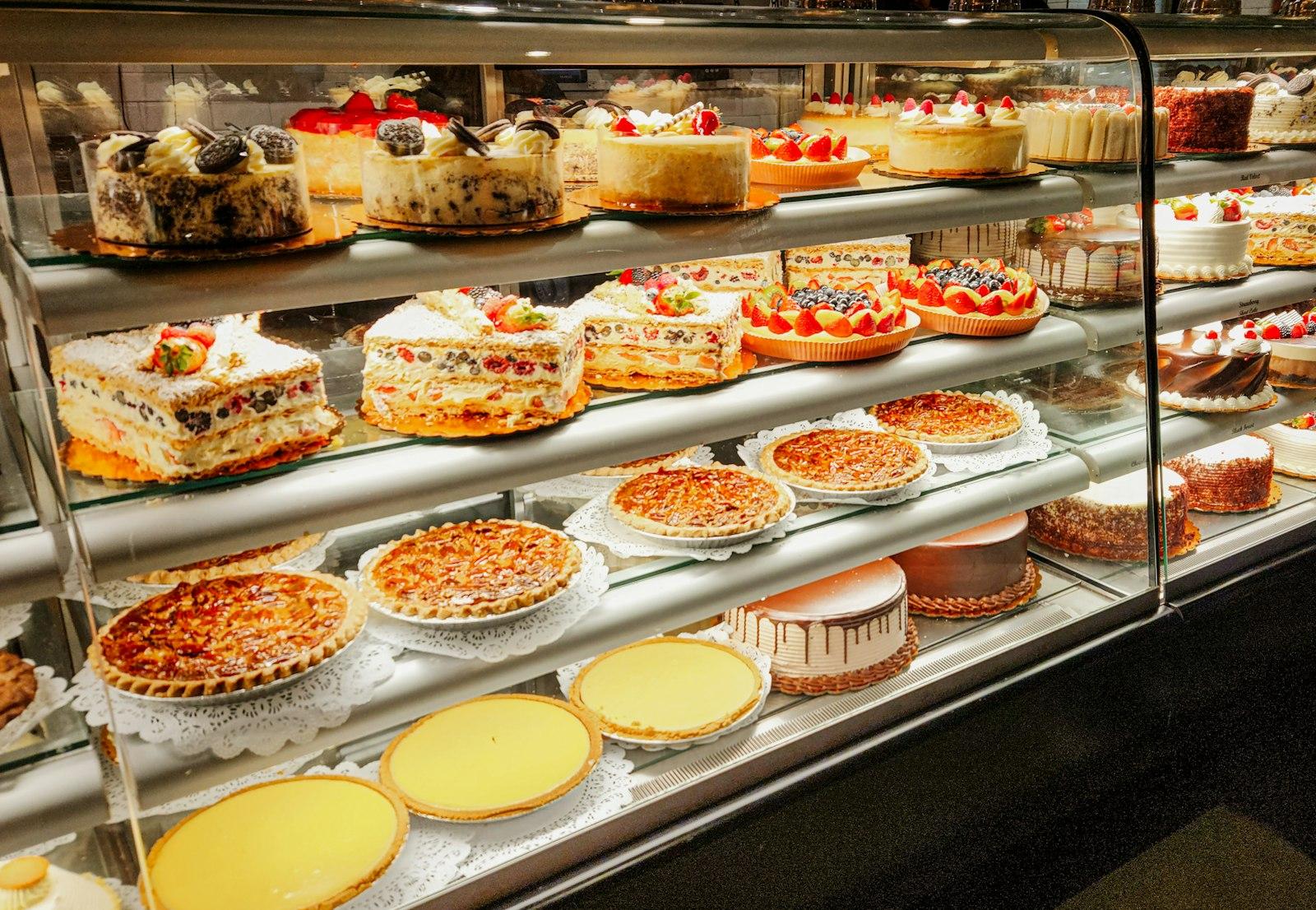
Ask for the same required details in every channel: name, phone number, product, quantity, pick-up day and slot, and for cakes also the inscription and special requests. You do not need more data than that. The number of guests or the cake size then sets the recipe quantity: the free recipe scaler scales dough and filling to match. If you sell cakes from your own production, the guide on the cake display case has tips on presentation and cooling.
Easter, Christmas and other peak days
On a handful of days a year a bakery makes a large share of its turnover: before Easter, before Christmas, on New Year’s Eve, on Mother’s Day and, in Austria, around All Saints’ Day. At the same time the bakehouse is at its limit. Pre-orders with a fixed deadline are the best tool on these days to avoid bottlenecks and long queues.
Set the range
About six weeks ahead, decide which holiday products you offer, in which sizes and at what price. The menu price calculator works out selling prices including VAT.
Announce
Four weeks ahead, inform customers on the website, Google profile, social media and in the shop, with the order deadline and pick-up days.
Remind
One week before the deadline, remind them again, in the shop with a stand-up sign and at the till.
Stick to the deadline
After it passes, only accept orders subject to availability, communicated honestly, so the plan holds.
Organise pick-up
A separate pick-up counter or shelf, orders sorted by number, extra staff at peak times.
Review
After the holiday, note quantities, leftovers and feedback: that is the basis for planning next year.
Also think about changed opening hours on the holidays themselves. Enter them early as special opening hours on your Google profile and display them in the shop. You can design a notice with the opening hours generator.
Pick-up slots and collection without queues
Click & collect only works if collecting is faster than normal shopping. Offer fixed time slots, for example every half hour, and limit the number of orders per slot. That spreads pick-ups across the morning and keeps your counter free for walk-in customers.
How to get it right
- Offer fixed pick-up slots per day and set a limit per slot
- Label every order with a number and name and keep them sorted
- Set up a separate pick-up counter or a “Pre-order pick-up” sign
- Say clearly how long an order stays reserved
- Confirm the order in writing, with pick-up time and price
Better not
- Leave pick-up times open so everyone turns up at eight
- Hand out pre-ordered goods in the normal queue
- Take orders verbally only, without confirmation
- Throw away uncollected cakes without calling first
- Accept more orders than the bakehouse can handle
Decide what happens to goods that are not collected: bread and rolls go back on sale after a set time, and for cakes you call the customer. Anyone who repeatedly fails to collect only orders with a deposit in future.
Deposits, cancellation and legal points
For standard goods such as bread or rolls a deposit is usually overkill. For custom cakes, wedding cakes and large platters it is common, because ingredients, decoration and working time would otherwise be lost. Many businesses ask for part of the price when the order is placed, or for payment upfront in the online shop. What matters is that the rule is clear beforehand: the amount of the deposit, until when customers can cancel free of charge and what applies after that. How to handle requests for individual cakes from the form to the order confirmation is shown in Online cake requests.
- Right of withdrawal: an order placed online, by phone or by chat is usually a distance contract. For goods that spoil quickly and for goods made to the customer’s specification, such as a custom cake, the law provides exceptions: in Austria § 18 FAGG (Distance and Off-Premises Contracts Act), in Germany § 312g BGB (Civil Code).
- Allergens: even for distance orders, allergen information must be available before the order is completed, for example in the shop or on the website. Details are in the allergen guides for Austria and Germany.
- Prices: in the online shop and on the website, every product needs its final price including VAT, holiday bakes included.
- Data: store only what you need for the order, and delete phone numbers and chats when they are no longer needed.
Promoting pre-orders on your website and Google
The best ordering system is useless if customers do not know it exists. The central hub is a dedicated “Pre-order” page on your website. It lists the range with photos and prices, lead times, pick-up slots, the deposit rule, allergen information and how to order: form, shop link or phone number. All other channels link to this page.
On your Google Business Profile you can add an order link and use posts to point to offers, such as “Pre-order Easter bread now, deadline Wednesday”. Posts can carry an image, text and a button; special opening hours for the holidays go into the same profile.
Pre-order checklist
- Pre-order range defined with photos, prices and allergens
- A lead time per product, and a fixed order deadline for holidays
- One or two order channels, all with written confirmation
- Pick-up slots and a pick-up counter organised
- Deposit and cancellation rule clearly worded and visible
- A dedicated “Pre-order” page on the website
- Order link and posts on the Google profile, special opening hours entered
- Notice in the shop and a reminder at the till
A website with a pre-order page, as a free preview
See how your bakery or café could look online with its range, opening hours and pre-orders before you decide.
A free preview of your venue website, designed by us.