Key points at a glance
- The basis is Art. 9 and 44 of the EU FIC Regulation (LMIV) and the Austrian Allergeninformationsverordnung (BGBl. II No. 175/2014): information on 14 major allergens must also be available for unpackaged food and drinks.
- You choose: in writing on the menu, a notice or a sign, or verbally by trained staff with a clearly visible notice.
- In every case you need written documentation of the ingredients (§ 4); for verbal information, also documented proof of training.
- The letter codes A to R are a recommendation of the health ministry, not an obligation; short names such as "milk" are allowed too, and a key is required.
- For online ordering and delivery, the allergen details must be available before the order is completed (Art. 14 LMIV).
This post is general information and does not replace legal or tax advice. Rules change and some differ between federal states: check the details with your chamber of commerce (WKO) or IHK, the competent authority or your tax adviser.
Legal basis: EU FIC Regulation and Allergeninformationsverordnung
The EU Food Information to Consumers Regulation (FIC, in German LMIV, Regulation (EU) No 1169/2011) lists in Annex II 14 substances that can cause allergies or intolerances. On packaged food they are highlighted in the list of ingredients. For unpackaged food, meaning everything that leaves the kitchen, bar or counter, Art. 44 LMIV also requires allergen information and leaves it to the member states how it is provided.
Austria regulated this in the Allergeninformationsverordnung, which came into force on 13 December 2014. It applies to all food businesses that supply unpackaged food to end consumers or provide mass catering: restaurants, Gasthäuser, cafés, bars, ice cream parlours, bakeries and pastry shops, snack stands, hotels, caterers, Buschenschanken and Heurige. According to the WKO (Austrian Economic Chamber), the obligation generally applies at festive events too, and it covers drinks: a cocktail with cream contains milk, beer contains barley and therefore cereals containing gluten.
The 14 major allergens and the letter codes A to R
In Austria, letters have become the standard abbreviation. They go back to a 2014 recommendation of the health ministry agreed in the Codex Commission. The regulation itself does not prescribe codes: short names such as "egg" or "celery" and clearly distinguishable pictograms are allowed too. Because guests know the letters, they are still the most practical choice.
| Code | Allergen | Typical kitchen pitfalls |
|---|---|---|
| A | Cereals containing gluten (wheat, rye, barley, oats, spelt) | breadcrumb coating, roux, beer, breadcrumbs |
| B | Crustaceans | prawns, fish soup, Asian pastes |
| C | Eggs | breadcrumb coating, pasta, mayonnaise, glaze |
| D | Fish | anchovies in sauces, Worcestershire sauce, fish sauce |
| E | Peanuts | satay, peanut oil, muesli, desserts |
| F | Soy | soy sauce, marinades, meat substitutes |
| G | Milk and lactose | butter, cream, quark, cheese, coffee drinks |
| H | Tree nuts | pesto, cakes, brittle, nut liqueur |
| L | Celery | soups, stocks, spice blends |
| M | Mustard | dressings, sauces, sausages, marinades |
| N | Sesame | baked goods, hummus, dressings |
| O | Sulphur dioxide and sulphites | wine, dried fruit, vinegar, potato products |
| P | Lupin | speciality flours, gluten-free baked goods |
| R | Molluscs | mussels, squid, oyster sauce |
What matters is a key explaining which letter stands for which allergen. It must be clearly visible and available together with the menu, ideally on the same page. The WKO also advises against numbers as abbreviations: numbers are mainly used for additives, especially in Germany, and could cause confusion. Our tool Allergen labelling for the menu creates a ready-to-print key.

Informing in writing or verbally
§ 3 of the Allergeninformationsverordnung gives you the choice. The information must be available, easily accessible and offered to guests without them having to ask. Both ways are equally valid and you may combine them, for example the standard menu in writing and daily or seasonal dishes verbally.
| In writing | Verbally | |
|---|---|---|
| Where | food menu, drinks menu, notice, sign at the display case or buffet, board | by staff on request |
| Requirement | codes or short names next to the dish, key clearly visible | clearly visible, legible notice that the information is available verbally (§ 3 (2)) |
| Staff | no proof of training needed | information only from trained staff, proof of training documented (§ 3 (3)) |
| Documentation | written ingredient documentation (§ 4) | written ingredient documentation (§ 4) |
| Well suited for | fixed menu, bakery, café, Imbiss | changing daily specials, small menus, Heuriger buffet |
With the verbal option, at least one trained person must be available in the venue during all opening hours; plan for holidays and sick leave. The original obligation to repeat the training every three years was dropped with the amendment BGBl. II No. 249/2017. The information passed on verbally must, however, always be up to date. You may train your team yourself if you have the necessary expertise; courses are offered by, among others, the Fachgruppen Gastronomie (hospitality trade groups) of the economic chambers.
Documentation: the basis of every answer
However you inform guests: under § 4 of the regulation, the allergen information must be based on written documentation. The format is up to you. A spreadsheet, a database, the POS system or a handwritten folder are all fine. You do not have to disclose recipes with quantities; guests have no right to see your recipes.
Record the ingredients of each dish
All ingredients that remain in the finished dish, including stocks, spice blends, thickeners, garnish and sauces. Break down compound ingredients such as pickled gherkins or pesto.
Assign the allergens
Check each ingredient for the 14 allergens; for ready-made products use the highlighted list of ingredients on the packaging.
Keep changes up to date
If a supplier or product changes, check the new list of ingredients. An equivalent product does not automatically have the same ingredients.
Update the menu and the team
Transfer new codes to the menu, website and notices, and brief the service staff.
How to get it right
- Name the allergens that are actually used as ingredients
- Keep cross-contact low with separate boards, knives and work areas
- Make clear what is inside for lesser-known fish species or fanciful dish names
- Give the information in German, offer multilingual keys in addition
Better not
- A sign at the entrance saying "This business is not suitable for people with allergies": according to the WKO, this does not comply with the law
- Blanket notes such as "All dishes may contain all allergens" instead of real information
- Advertising dishes as "allergen-free": guests read that as a guarantee
- Changing the menu without updating the documentation
Buffet, counter, breakfast and events
At a buffet or display case there is no menu next to the plate, so small signs with the name and codes right by each dish work well. For a hotel breakfast, a uniform sign system that the team swaps when refilling pays off. Alternatively, the verbal option remains, with a clearly visible notice and trained staff at the buffet. The same applies to catering and banquets: the information has to reach the guest, not just appear in the offer to the organiser.
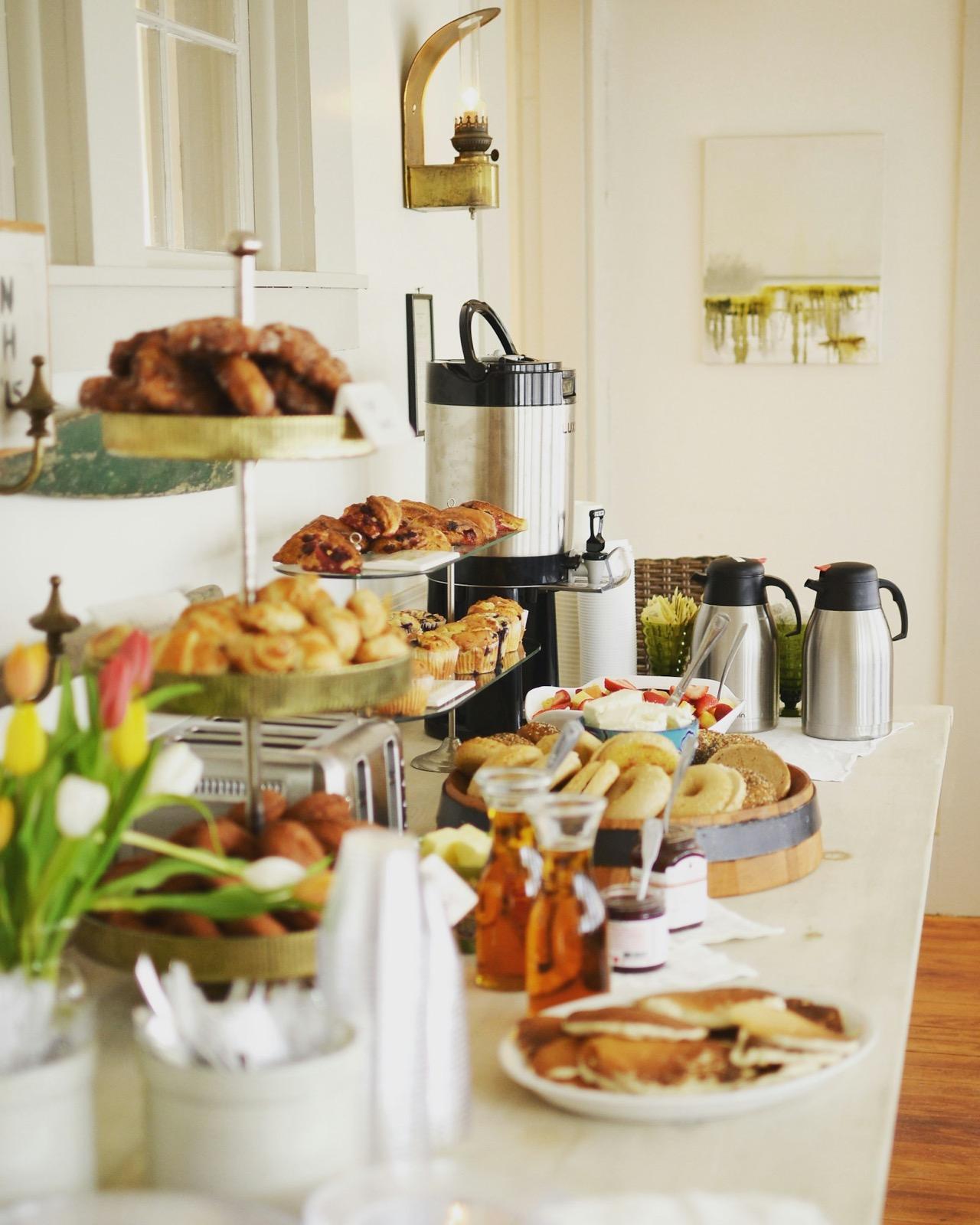
For Heurige and Buschenschanken with a changing range of spreads and cold platters, a board combined with verbal information is common. More on running a Heuriger in the guide Opening a Heuriger, and for cafés and bakeries in Opening a café in Austria.
Online menu, ordering and delivery
If you sell food via your own website, by phone or through platforms such as Lieferando, Wolt or foodora, you are concluding a distance contract. Under Art. 14 LMIV, the mandatory information, which for unpackaged food means the allergens, must be available before the purchase is completed and must be provided at the latest on delivery. Verbal information in the venue is not enough for this: the codes belong right next to every dish in the ordering process, with the key.
- Your own website: show the allergens with every dish on the digital menu, not just in a PDF at the bottom of the page.
- Delivery platforms: fill in the allergen fields in your partner portal and update them when recipes change. You remain responsible. More in the guide Delivery platforms.
- Information-only menu online: even if nobody orders there, it should match the menu in the venue, for allergens as well as prices (see Price labelling in Austria).
- QR code on the table: a digital menu only replaces the printed one if every guest can easily access the information. Keep printed copies at hand.
An allergen key in one minute
Create a free key with the codes A to R for your menu, notices and website, in several languages.
Inspections by the food authority and penalties
Compliance is checked by the food inspectorates of the federal states during their inspections. They check the information for guests, the documentation and, for verbal information, the proof of training. If there are shortcomings, the authority usually first issues an order under § 39 LMSVG (Austrian food safety act) with a deadline to fix them. Breaches are also administrative offences under § 90 LMSVG, with fines of up to 35,000 euros, or up to 70,000 euros for repeat offences. Worse than any fine is a guest who ends up in hospital after a meal.
Allergen information under control
- Format chosen: written, verbal or combined
- Ingredient documentation set up for every dish and drink
- Codes or short names next to every dish, key clearly visible
- For verbal information: notice in place, proof of training filed, a trained person on every shift
- Website, delivery platforms and printed menu show the same information
- Procedure for supplier or recipe changes defined
Your menu online, allergens included
With Meine-Gastro-Website you manage dishes, prices and allergen codes in one place. See how your venue could look online.
A free preview of your venue website, designed by us.