Key points at a glance
- Leftovers cost more than ingredients: working time, energy and disposal go into every unsold item. Measure them per product and weekday.
- The key figures are the return rate, the sell-out time and the recovery rate. They show where you bake too much and where too little.
- Plan quantities using till data from recent weeks, the weather, holidays and local events, and prefer to bake in several smaller batches.
- Whatever is left becomes day-old goods, an ingredient for breadcrumbs, dumpling bread or bread chips, a bag in apps like Too Good To Go or a donation to food banks and social supermarkets.
- Pre-orders and a clear message to customers ("Small selection in the evening") make planning more reliable than any formula.
This post is general information and does not replace legal or tax advice. Rules change and some differ between federal states: check the details with your chamber of commerce (WKO) or IHK, the competent authority or your tax adviser.
What unsold goods really cost
In a bakery, "returns" (Retouren in German) means everything that was not sold by the end of the day: what is left in your own counter and what comes back from branches or resellers such as supermarkets, petrol stations or canteens. Many businesses only look at the cost of ingredients: flour, butter, eggs and fillings. That seriously underestimates the damage, because a loaf that ends up in the bin has gone through the entire production process.
| Cost type | Examples | How visible? |
|---|---|---|
| Ingredients | Flour, butter, seeds, fillings, packaging | Clearly visible in the costing |
| Working time | Mixing, shaping, baking, selling, clearing up | Often forgotten |
| Energy | Oven, refrigeration, retarder proofer | Hidden in fixed costs |
| Logistics | Trips to the branches and back | Significant for multi-branch bakeries |
| Disposal | Organic waste bin, collection by recyclers | Small item, but ongoing |
| Image | Empty shelves or full bins | Not in the figures, but noticeable |
If you cost your prices properly, you already include a realistic share of leftovers. Our guide to menu costing shows how this works for dishes and baked goods, and the price calculator works out the selling price per item. So the goal is not zero leftovers, but a deliberately chosen, as small as possible quantity that you then put to good use.
The key figures you need
Without figures, baking plans remain gut feeling. You don't need expensive software: a modern till provides sales per product and hour, and a simple leftovers list in the evening adds what remained. What matters is that all staff record leftovers the same way, ideally in pieces and per product, not as a rough estimate like "one basket of pastries".
| Key figure | How to calculate it | What it shows |
|---|---|---|
| Return rate | Unsold pieces ÷ pieces produced × 100, per product and weekday | Where you consistently bake too much |
| Return value | Unsold pieces × production cost per piece | What leftovers actually cost |
| Sell-out time | Time of day a product runs out | Where you bake too little and lose sales |
| Batch quantity | Pieces from later baking runs | How flexible your planning already is |
| Recovery rate | Leftovers resold, processed or donated ÷ all leftovers × 100 | How much is still put to use |
An example: on a Tuesday you bake 400 rolls and 36 are left over. Your return rate is 9 percent. If 20 of them are turned into dumpling bread or breadcrumbs and 16 are donated, your recovery rate is 100 percent, but the return value is still a cost. That is why both figures belong together: you lower the first with planning and raise the second with recovery.
Baking plans based on data, not gut feeling
The best basis for tomorrow's quantity is the sales of the same weekday over recent weeks. A Monday is not a Saturday, and a Friday before a public holiday behaves differently from a normal Friday. Many till systems export sales as a spreadsheet; some offer their own forecasting or connect to planning software for bakeries. Start simple and refine over time.
Set a baseline
For each product, calculate the average pieces sold on the last four to six identical weekdays, leaving out outliers such as public holidays.
Plan adjustments
Deliberately factor in the weather, school holidays, public holidays and bridge days, markets, events and roadworks outside the door. In hot weather, bread and rich cakes sell worse, while pastries and fruit cakes often sell better.
Set the first batch
Don't bake the whole day's quantity early. Bake a share for the morning and prepare the rest for later runs, for example as chilled or frozen dough pieces. The recipe scaler adjusts your dough quantities to the planned number of pieces.
Compare in the evening
Record leftovers and sell-out times per product and compare them with the plan. If a product repeatedly deviates in the same direction, adjust the baseline.
Review weekly
Once a week, look at the figures per product: what is reliably overbaked, what always runs out too early, which varieties are hardly needed any more?

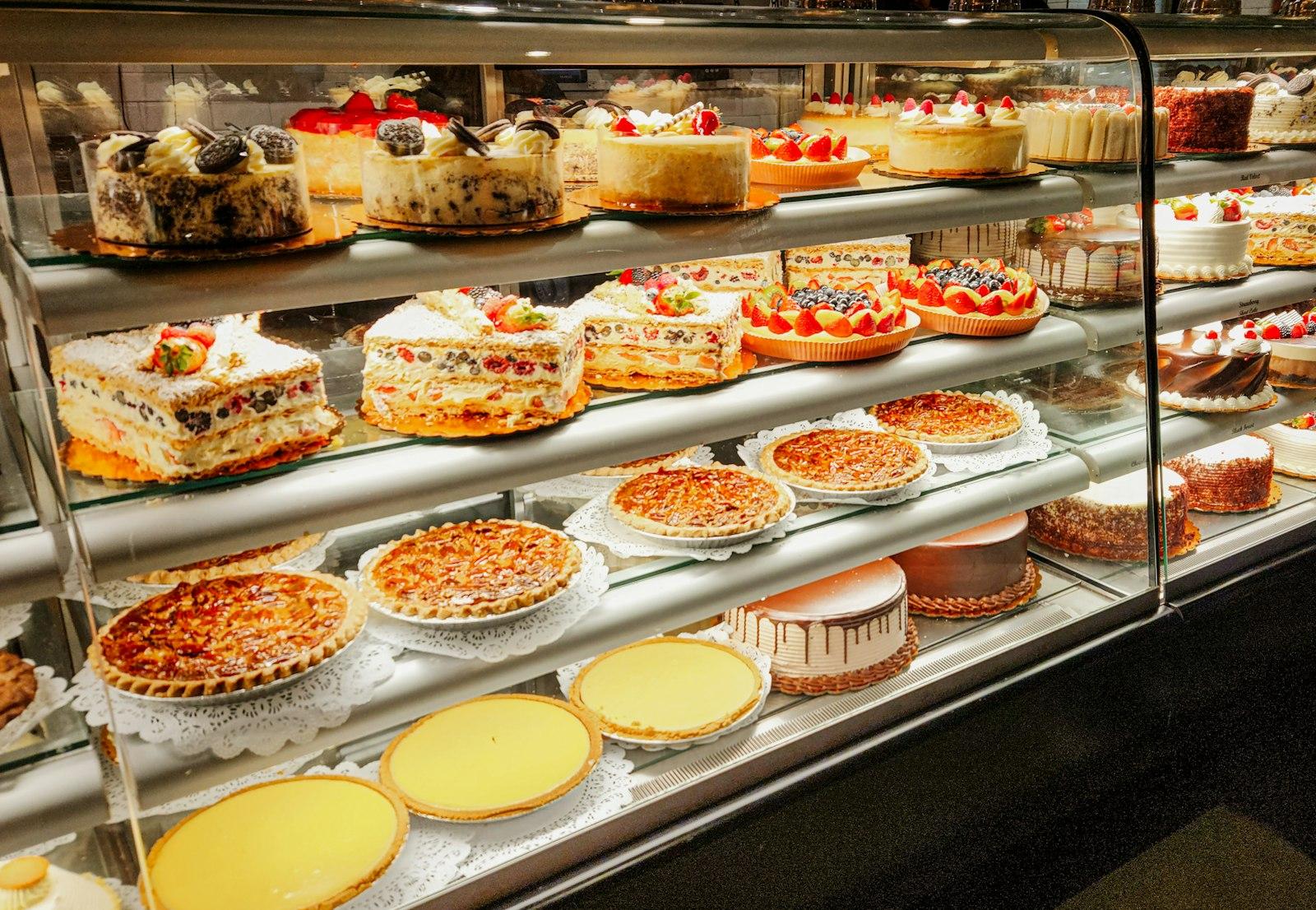
Review the range itself, too. Twelve kinds of bread in the display look great, but they mean twelve times the risk of leftovers. Rare varieties can be offered on certain days or baked only to order. The same applies to the cake display: better fewer varieties in sufficient quantity than many cut cakes left over in the evening. More on the display case in our guide to cakes and tortes in the café.
Batch baking during the day and a lean evening range
The most effective lever against waste is not to have everything ready early in the morning. With retarder proofing, chilled dough pieces or an in-store oven in the branch, you bake small quantities throughout the day, exactly when demand comes. Customers also love the smell of fresh pastries in the afternoon. What matters is a clear rule on who bakes what and when, based on which signal, for example: "When less than half a tray of Kaiser rolls is left in the display, bake more; after 4 pm, only half a tray at a time."
How to get it right
- Set fixed baking times and minimum stock levels per product
- Deliberately offer only a small core range after a certain time
- Put up signs like "Small selection in the evening, but fresh"
- Let best-sellers run out last and niche varieties earlier
- Involve the team: those who sell are the first to see what is left
Better not
- Keep a full display until closing at any cost
- Bake more of every variety until the evening
- Plan in the bakehouse without feedback from the shop
- Mix day-old goods with fresh ones without saying so
- Throw leftovers away in the evening without counting them first
A lean evening range takes courage, because some customers expect a full counter. Explain your decision openly: many people appreciate a bakery that throws away less. Anyone who wants something specific in the evening can pre-order it.
Day-old goods and processing
Bread from yesterday is not an inferior product but an offer in its own right. Many bakeries have a shelf or basket of day-old goods at a reduced price. Label these goods clearly and keep them separate from fresh ones so that nobody is misled. Hearty sourdough loaves work better for this than rolls, which quickly turn chewy. Whatever no longer sells can be processed in your own bakehouse or kitchen.
- Breadcrumbs and dumpling bread or bread cubes: dry, grate or dice them and sell them packed.
- Bread chips and croutons: baked with oil and spices, as a snack at the till or for salads in the café.
- Old bread in new dough: soaked as a scald, stale bread improves freshness and flavour in many recipes.
- Sweet uses: bread and butter pudding, Scheiterhaufen (an Austrian bread pudding), rum balls or cake bases from leftover pastries and sponge.
- Breakfast and lunch: toast, open sandwiches, bruschetta or French toast in your own café area.
Too Good To Go, food banks and other outlets
Whatever is left despite good planning doesn't have to go in the bin. Apps like Too Good To Go are widely used in Austria and Germany: you list a "Surprise Bag" with the day's goods at a reduced price, customers reserve and pay in the app and collect the bag in a set time slot shortly before closing. The provider names its terms and fees when you register. Besides the revenue, the app brings new customers into the shop who may later buy at full price.
Donations to food banks and social supermarkets are the second pillar. In Germany, the local Tafel food banks organise collection from bakeries; in Austria, food banks, social supermarkets and charities do the same. Agree in advance which goods and quantities are needed, when they are collected and how they are handed over. For businesses in Germany, Tafel Deutschland explains on its website how donations work; in Austria, a guide from the agriculture and health ministries covers passing on food to social institutions. Clarify tax questions about donations in kind with your tax adviser.
| Outlet | Advantage | What to watch |
|---|---|---|
| Day-old shelf in the shop | Revenue, regulars for lower-priced goods | Clearly separated and labelled |
| Processing | New product with its own margin | Working time, HACCP, labelling |
| Too Good To Go and similar apps | Revenue in the evening, new customers | Pick-up time, fees, don't sell off your main range |
| Food banks and social supermarkets | Food helps people | Agreement on quantities, collection and hygiene |
| Animal feed or biogas | Recovery instead of waste | Only via licensed, specialised buyers |
The order works like a pyramid: first bake less, then use leftovers as food for people, and only then as animal feed or energy. A mixed model works best for many businesses, for example a day-old shelf for bread, the app for mixed pastries and the food bank for larger quantities before holidays.
Pre-orders and talking to your customers
Every pre-order adds certainty to your planning. Cakes, bread for parties, breakfast hampers or Sunday pastries can be ordered by phone, email, a form on your website or click and collect. Our guide to pre-orders and click and collect shows how to set it up. Especially before Easter, Christmas and long weekends, pre-orders cut leftovers noticeably, because you no longer have to guess.
Share your commitment publicly, too. A short page on your website about day-old goods, Too Good To Go and donations, up-to-date opening hours in your Google Business Profile and a note on Instagram when the day-old shelf has been refilled show customers that you value food. If you run a bakery with seating, you can also use leftovers in your breakfast menu, see bakery with a café area.
Pre-orders straight through your website
Your own bakery website with your range, opening hours and a pre-order form makes your baking plans more reliable. See a free preview for your business.
A free preview of your venue website, designed by us.
Checklist: reducing waste
- Record leftovers every evening per product in pieces
- Note the sell-out times of your best-sellers
- Plan quantities based on the last four to six identical weekdays
- Factor in the weather, holidays and events
- Set baking times and minimum stock levels
- Deliberately shrink the evening range and explain it to customers
- Offer day-old goods clearly separated and labelled
- Organise processing, an app and a food bank as regular outlets
- Offer pre-orders for cakes, parties and holidays
Sources
- Tafel Deutschland: Donating food (German)
- BMLUK (Austrian ministry): Passing food on to social institutions (German)
- Too Good To Go: Food rescue for bakeries (German)
- Zu gut für die Tonne!: German federal ministry initiative against food waste
- EUR-Lex: Regulation (EU) No 1169/2011 (Food Information to Consumers, LMIV)