Key points at a glance
- Buffet, à la carte or a mix: the choice depends on the number of rooms, occupancy, staff and space, not on prestige.
- Local produce such as bread from the village baker, cheese, eggs and honey from nearby pays off if you make it visible at the buffet and on your website.
- Work out the cost per guest from food, staff and leftovers, not just from purchasing. The breakfast price for outside guests and for room-only bookings builds on it.
- Allergens must be identifiable at the buffet too, in writing or through trained staff, depending on the rules in Austria and Germany.
- Avoid leftovers by planning to occupancy, using smaller bowls and refilling instead of overfilling. Outside breakfast guests bring revenue but need the right trade licence.
This post is general information and does not replace legal or tax advice. Rules change and some differ between federal states: check the details with your chamber of commerce (WKO) or IHK, the competent authority or your tax adviser.
Buffet, à la carte or a mix?
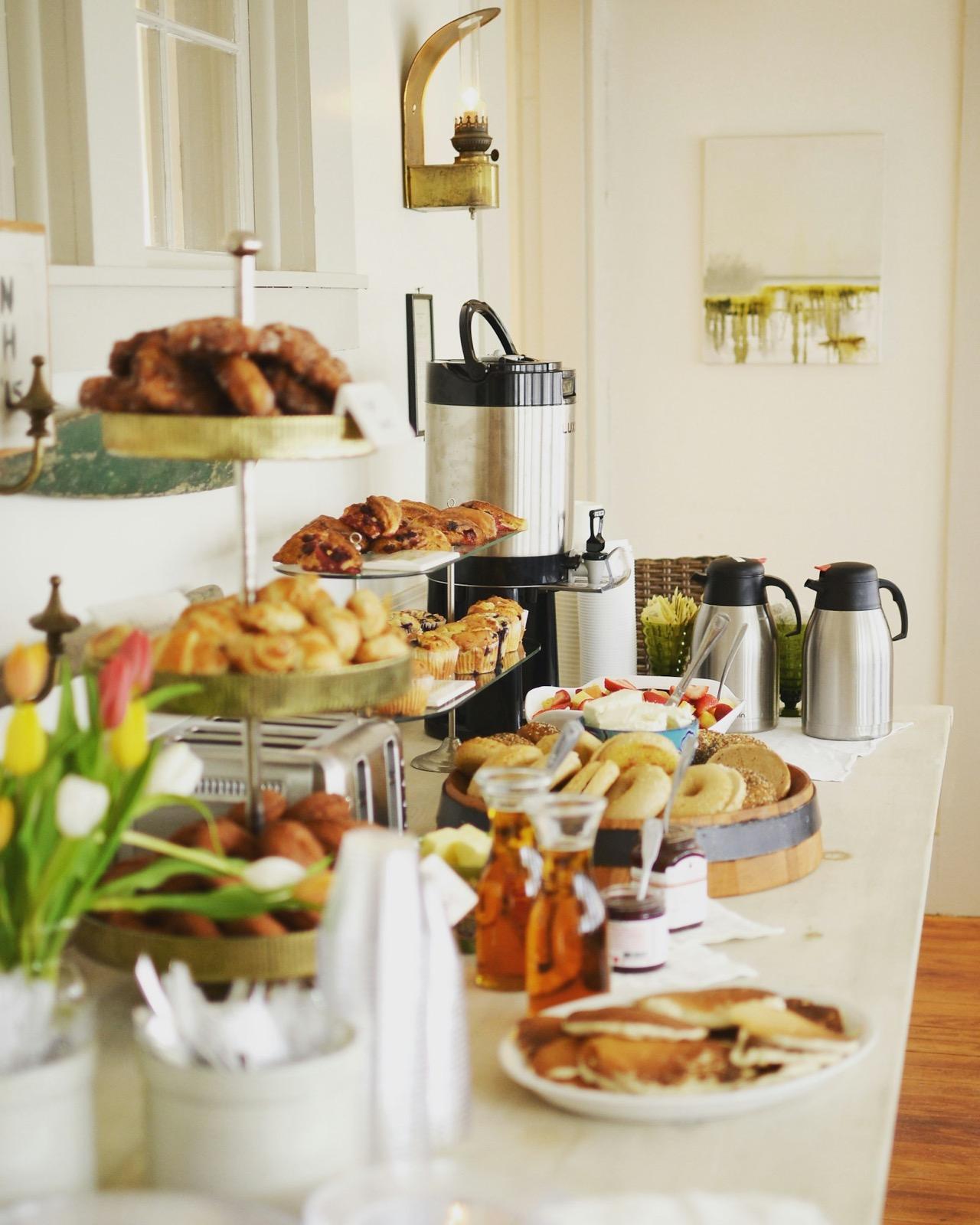
The classic breakfast buffet is standard in Austria and Germany, but it is not the best solution for every property. For a guesthouse with six rooms, a full buffet means a lot of food for few guests every morning. A city hotel with 60 rooms, on the other hand, can hardly get through the rush between 7:30 and 9 without one. What matters is the number of rooms, occupancy, staff, space in the breakfast room and what your guests expect.
| Format | Suits | Advantages | Disadvantages |
|---|---|---|---|
| Full buffet | Medium and larger properties, high occupancy | Guests choose freely, little table service, fast at peak times | More leftovers, high food cost, hygiene effort |
| À la carte | Small guesthouses, boutique hotels, fluctuating occupancy | Hardly any leftovers, freshly made, personal impression | More staff per guest, longer waits when busy |
| Small buffet plus menu | Properties with 10 to 40 rooms | Bread, spreads, muesli and fruit at the buffet, egg dishes made to order | Kitchen and service routines must run smoothly |
| Breakfast basket or tiered stand at the table | Holiday apartments, very small properties, low season | Easy to plan, little food, feels premium | Less choice, special requests must be asked in advance |
Many properties do well with a seasonal mix: a full buffet in high season, a small buffet with egg dishes to order in low season. The key is that guests know what to expect before they book. State clearly on your website and in the booking confirmation whether there is a buffet or table service, when breakfast is served and what is included in the room rate.
Buy locally and show it
Local sourcing is especially credible at breakfast because the products are simple and easy to recognise: bread and pastries, butter, cheese, cold cuts and ham, eggs, yoghurt, honey, jam, juices and coffee. A basket of rolls from the village baker and eggs from the farm next door say more about your property than any glossy photo. Guests ask about it, too: if you offer local produce, show it.
- Name your suppliers: small signs at the buffet such as “Mountain cheese from the XY dairy” or “Eggs from the Huber farm, 3 km away”.
- A few products, consistently: better five genuinely local products than a vague “from the region” on everything.
- Change with the seasons: strawberries in June, plum compote in autumn, homemade jam from your own garden.
- Agree on quantities: small producers often do not deliver daily. Settle fixed delivery days and minimum orders in advance.
- Stay honest: only claim what is true. Buying from a wholesaler is fine as long as you do not pass it off as farm produce.
How to communicate local cuisine credibly and find suppliers is covered in more detail in the guide to regional cuisine. For your breakfast, a good start is often enough: a baker, a cheese dairy and a farm for eggs and dairy products.
Costing: what does breakfast cost per guest?
Many hosts know what they spend on purchasing, but not the real cost per breakfast guest. Besides food, it includes staff in the morning, leftovers, cleaning, laundry and energy for the coffee machine and dishwasher. Only once you know this figure can you decide what breakfast should cost for outside guests or for room-only bookings, and how much of it is in the room rate.
Record a month of food costs
Add up all invoices for breakfast goods in a representative month, including coffee, tea, milk and juices.
Count breakfast guests
Take the number of breakfasts actually served from the till or occupancy list, not the number of overnight stays.
Calculate food per guest
Food cost divided by breakfast guests. This figure already includes the leftovers.
Add staff
Hours for set-up, service, clearing and washing up times the hourly rate including payroll costs, divided by breakfast guests.
Estimate overheads
Add a share for energy, laundry, cleaning and breakages. Your tax advisor can help with realistic values.
Derive the price
Set the selling price for outside guests and the breakfast share of the room rate from the cost per guest and your target food cost.
| Item | Per month | Per breakfast guest |
|---|---|---|
| Food (incl. drinks and leftovers) | €4,050 | €4.50 |
| Staff (set-up, service, clearing) | €3,150 | €3.50 |
| Energy, laundry, cleaning | €450 | €0.50 |
| Total cost | €7,650 | €8.50 |
The figures are only an example. Your own values depend heavily on your offer, region, purchasing and staff. Calculate with your own invoices and rotas, not with averages from the internet. How breakfast fits into your room rate, including packages and seasonal prices, is explained in the guide to setting room rates.
Calculate the breakfast price for outside guests
Enter your cost per guest and your target food cost: the price calculator works out the selling price including VAT for Austria and Germany.
Allergens at the breakfast buffet
Allergen information under the EU Food Information Regulation applies at the buffet as well: guests must be able to find out which of the 14 major allergens a product contains. This concerns above all unpackaged food such as pastries, spreads, muesli, cakes, egg dishes and homemade jams. Exactly what the information must look like is set by national rules: in Austria the Allergeninformationsverordnung, in Germany the Lebensmittelinformations-Durchführungsverordnung (LMIDV). You will find the details in the guides allergen labelling in Austria and allergen labelling in Germany.
Allergens at the buffet under control
- Small signs on every unpackaged product with its name and allergens, for example with letter codes and a legend
- Allergen list of all breakfast products as a folder at the buffet or at reception
- Keep recipes and supplier ingredient lists up to date, check them when you change suppliers
- Separate tongs and spoons for each bowl so that nuts, gluten and the like do not mix
- Store and label gluten-free bread and lactose-free milk separately
- Train staff so that questions are answered immediately and correctly
- Ask about intolerances at booking or check-in
Create a clear legend of the 14 allergens and their codes for buffet signs and the folder for free with the allergen legend.
Avoid leftovers without looking stingy
In many properties, the breakfast buffet produces most of the day's food waste. The reason is usually the same: the buffet is supposed to look full until the very last minute. With a little planning it stays inviting, and much less ends up in the bin. That saves money and also goes down well with guests who care about sustainability.
How to get it right
- Plan quantities by the day's occupancy and departures, not by gut feeling
- Use smaller bowls and platters and refill more often
- Deliberately refill less towards the end of breakfast
- Make egg dishes, pancakes and juices fresh to order
- Measure leftovers: weigh what remains for a week, then adjust quantities
- Use the previous day's bread for dumplings, croutons or bread crisps in the restaurant, provided it is hygienically sound
Better not
- Set out huge platters that are meant to stay full until the end
- Order the same amount every day, no matter how many guests are in house
- Put unpackaged food from the buffet out again the next day
- Never analyse waste and only complain about purchasing costs
- Lecture guests with signs instead of steering the offer cleverly
Routines and staff in the morning
A good breakfast stands or falls with its routines. Whoever heats up the oven, makes coffee and sets up the buffet at six in the morning needs clear lists, fixed places and enough time. In small guesthouses, the owner often does this personally. That is exactly when it pays to standardise set-up and quantities, so that a stand-in can take over immediately during holidays or illness.
The evening before
Check occupancy, departures and special requests, lay the tables, prepare chilled goods according to the list.
Before opening
Start the coffee machine and dishwasher, stock the buffet according to the set-up plan, check refrigeration and temperatures.
During breakfast
Refill in small amounts, clear tables quickly, make egg dishes to order, greet guests personally.
After breakfast
Return chilled goods to the fridge, dispose of or reuse open leftovers according to hygiene rules, note the leftovers.
Once a week
Review leftovers, purchasing and guest feedback and adjust quantities and offer.
Also keep breakfast times identical everywhere: on the website, in your Google Business Profile, in the room and in the booking confirmation. The opening hours generator creates a consistent format for the printed notice and your Google profile. Guests from other countries sometimes expect different times, and a late weekend breakfast until 10:30 can be a real selling point. And because breakfast is mentioned so often in reviews, it is also a good moment to kindly ask satisfied guests for a review when they leave, for example with a review QR code at reception.
Offering breakfast to outside guests
A breakfast room that is half empty at 9:30 can bring in extra revenue: with breakfast for guests from outside, for hikers, cyclists, local business people or guests of holiday apartments without their own breakfast. Before you offer it, check the legal side, your capacity and the price.
- Austria: small properties with no more than ten guest beds often run accommodation with breakfast as a free hospitality trade (freies Gastgewerbe) under § 111 Abs. 2 Z 4 GewO. Whether and to what extent this also lets you serve guests who do not stay with you is something to clarify in advance with the Chamber of Commerce (WKO) or the trade authority. The regulated hospitality trade puts you on the safe side, see opening a guesthouse in Austria.
- Germany: under § 2 Abs. 2 Nr. 4 GastG, food and drinks for house guests are allowed without a restaurant licence. If you also serve outside guests, you are running a restaurant to that extent. Whether a licence or a notification is required depends on the federal state and on whether you serve alcohol, see opening a guesthouse or hotel in Germany.
- Capacity: only admit outside guests at times when seats are free, for example after 9 am or in low season. House guests come first.
- Price and display: show the breakfast price for outside guests clearly, on the website as well as at the entrance or reception.
For outside guests to hear about it at all, breakfast needs its own place online: a separate page or a clear section on the website with times, price, photos and a note on reservations, plus breakfast times in your Google profile. That way your property will be found for searches like “breakfast near me”. Mention the location in the text too, such as “breakfast on Lake Wolfgang” or “breakfast in the old town”. And if you use breakfast as a perk for direct bookers, you will find tips in the guide to direct bookings.
Hotel breakfast checklist
- Breakfast format chosen to suit rooms, occupancy and staff
- Three to five local products named with their supplier at the buffet
- Cost per breakfast guest calculated from food, staff and overheads
- VAT on breakfast clarified with your tax advisor
- Allergens identifiable on all unpackaged products, staff trained
- Quantities planned by occupancy, leftovers measured for a week
- Set-up plan and routine list available for stand-ins
- Breakfast times identical on website, Google profile and in the room
- For outside guests: trade licence checked, price displayed
Your breakfast on your own website
Rooms, breakfast, photos and direct booking on one website: see a free preview for your guesthouse or hotel.
A free preview of your venue website, designed by us.