Key points at a glance
- Count footfall instead of guessing: on several weekdays, at lunchtime, in the afternoon and in the evening, split by direction and target group.
- What matters is not the raw number of passers-by but how many of them have the hunger, time and reason to buy what you sell.
- Competition is not automatically bad: a street food strip attracts guests, while a second kebab shop right next door splits demand.
- Weigh rent or pitch fees against realistic sales, with scenarios for weak months and bad weather.
- Markets, private car parks and events are good test grounds before you commit to a long lease.
This post is general information and does not replace legal or tax advice. Rules change and some differ between federal states: check the details with your chamber of commerce (WKO) or IHK, the competent authority or your tax adviser.
Why location matters so much for a snack bar
A restaurant with a good reputation can sit on a side street: guests book a table and come on purpose. A snack bar, by contrast, lives largely on passing trade: people who get hungry during their lunch break, on the way to the train or after a night out. If you are a few hundred metres away from the stream of passers-by, you lose these impulse purchases, and no amount of advertising makes up for that in the long run.
At the same time, the best spot is rarely the most expensive one. A corner right on the main square can cost so much rent that the snack bar does not pay its way despite plenty of guests. A good location fits your concept, price level and opening hours: a breakfast and coffee stand needs morning commuters, a burger joint the lunch break of offices and schools, a kebab shop also night owls at the weekend. The legal steps of starting up are covered in the guides on street food and food trucks in Austria and in Germany; this guide is only about choosing the spot.
Measure footfall instead of guessing
The gut feeling that “it is always busy here” is often misleading. Some streets are only full on Saturdays, others only during term time. Some passers-by walk briskly to the underground or the train and never stop. So count yourself, with a counter app on your phone or a tally sheet. Some cities, town centre associations or estate agents also have footfall counts for shopping streets. Ask for them, but do not rely on them alone.
Set time slots
Count exactly when you plan to sell: for example 11:30 to 14:00, 16:00 to 19:00 and weekend evenings.
Choose several days
At least one normal weekday, a Friday and a Saturday, ideally also in the rain and during school holidays.
Count in intervals
Count for 15 minutes at a time and extrapolate. Note the direction, because people buy more on the way home than on the way to work.
Note the target group
Roughly distinguish pupils, office workers, families, tourists and construction workers. This shows whether your offer and prices fit.
Watch the competition
How long are the queues next door at 12:30? Busy snack bars nearby are a good sign of real demand.
| Metric | Location A (high street) | Location B (near a vocational school) |
|---|---|---|
| Passers-by per hour at lunchtime | 900 | 350 |
| Assumed conversion rate | 1 % | 4 % |
| Guests per lunch hour | 9 | 14 |
| Average ticket (assumption) | 9 euros | 8 euros |
| Sales per lunch hour | 81 euros | 112 euros |
The conversion rate is the big unknown. Estimate it cautiously and calculate several variants. The example shows the key point: fewer people who match your offer exactly often bring more sales than many people who just walk through.
Passing trade: who really walks by?
Footfall drivers are places that attract people regularly and at fixed times. The more of them lie within a few minutes' walk and the better their times match your opening hours, the more stable your sales will be. Also notice which side of the street people walk on and where traffic lights or stops make them wait briefly: people who are standing still anyway are more likely to buy.
- Transport hubs: railway stations, underground and suburban rail stations, tram and bus interchanges with people changing lines.
- Work and education: office buildings, business parks, schools, vocational schools, universities and hospitals with shift work.
- Leisure: pedestrian zones, shopping centres, parks, bathing lakes, stadiums, clubs and bars for late-night trade.
- Building sites and companies without a canteen: often loyal regulars at lunchtime, but only for the duration of the project.
- Seasonal flows: tourists in summer, skiers in winter, markets and festivals on certain days.

Reading competition and surroundings correctly
Walk the area within roughly five to ten minutes on foot and note every place where your target group eats at lunchtime or in the evening: snack bars, bakeries with snacks, supermarkets with ready meals, canteens and delivery services. Look at their prices, opening hours, waiting times and reviews. Gaps are worth more than copies: if there are three kebab shops but nothing vegetarian or nothing open after 9 pm, that is your chance.
A street food strip or a street food market can be an advantage, because guests come on purpose to choose. That works if you clearly stand out. An almost identical offer right next to an established vendor, on the other hand, usually ends in a price war. Also pay attention to neighbours who could cause trouble: flats directly above the extractor outlet, a café with its own snacks or a property manager who dislikes smells and queues.
How to get it right
- Visit the competition during your selling hours and watch the queues
- Read your neighbours' reviews: what do guests complain about?
- Look for a real gap in offer, time of day or price
- Count supermarkets and bakeries as lunchtime competition
Better not
- Put the same concept right next to a popular vendor
- Only consider other snack bars as competition
- Judge a location on a single sunny Saturday
- Meet the neighbours and the property manager only after signing
Calculating rent, lease and pitch fees
For a small snack bar, rent is often the biggest fixed cost after staff. It is due every month, even in a rainy November. So calculate backwards: what monthly sales are realistic at this location, in a weak and in a good case? How much of that is left after cost of goods, staff, energy and taxes? Only then do you know how much rent is affordable. How to calculate cost of goods and prices is explained in the guide on costing in hospitality, and specifically for döner, meal deals and packaging in costing döner and snack bar food.
| Type of location | Typical costs | What to look out for |
|---|---|---|
| Shop unit | Monthly rent, service charges, deposit, often a key money payment | Extraction and grease trap possible? Minimum term, indexation, conversion costs |
| Kiosk or fixed stand | Rent or lease, sometimes a municipal fee for using public space | Who pays for electricity, water and maintenance? How long does the permit run? |
| Private land (supermarket, petrol station) | Fixed pitch rent or a share of sales | Written contract, power and water connection, notice period |
| Weekly market | Market fee per day or season | Allocation by the municipality or operator, product rules, waiting lists |
| Events and festivals | Pitch fee, share of sales or both | Judge visitor numbers honestly, weather risk, minimum sales |
Visibility, access and parking
A snack bar has to be recognisable as a snack bar from several metres away. Check whether your unit can be seen from both walking directions, whether trees, scaffolding or advertising boards hide the front and whether an A-board or an illuminated sign is allowed. Many municipalities have their own rules for signs and advertising on the pavement, and the property manager has a say too. An open serving hatch, a clearly legible board with prices and the smell from the grill are often the best advertising.
- Room to wait: is there space for a queue without blocking the pavement?
- Parking and stopping: drivers, delivery riders and taxis need a place to stop briefly nearby.
- Bikes and pedestrians: bike racks and step-free access widen the circle of guests.
- Seats and standing room: outdoor seating, benches nearby or a standing counter make stopping more comfortable. Keep within the limits of your trade licence.
- Deliveries and pick-ups: where does your supplier stop, and where do riders from delivery platforms collect orders?
Visibility today also means being visible online. Many guests search for “snack bar near me” on the go and decide by distance, opening hours and reviews. A complete Google Business Profile with photos and your own website with a menu are therefore part of choosing a location. How to rank higher in local searches is explained in the guide on local SEO.
Markets, pitches and mobile locations
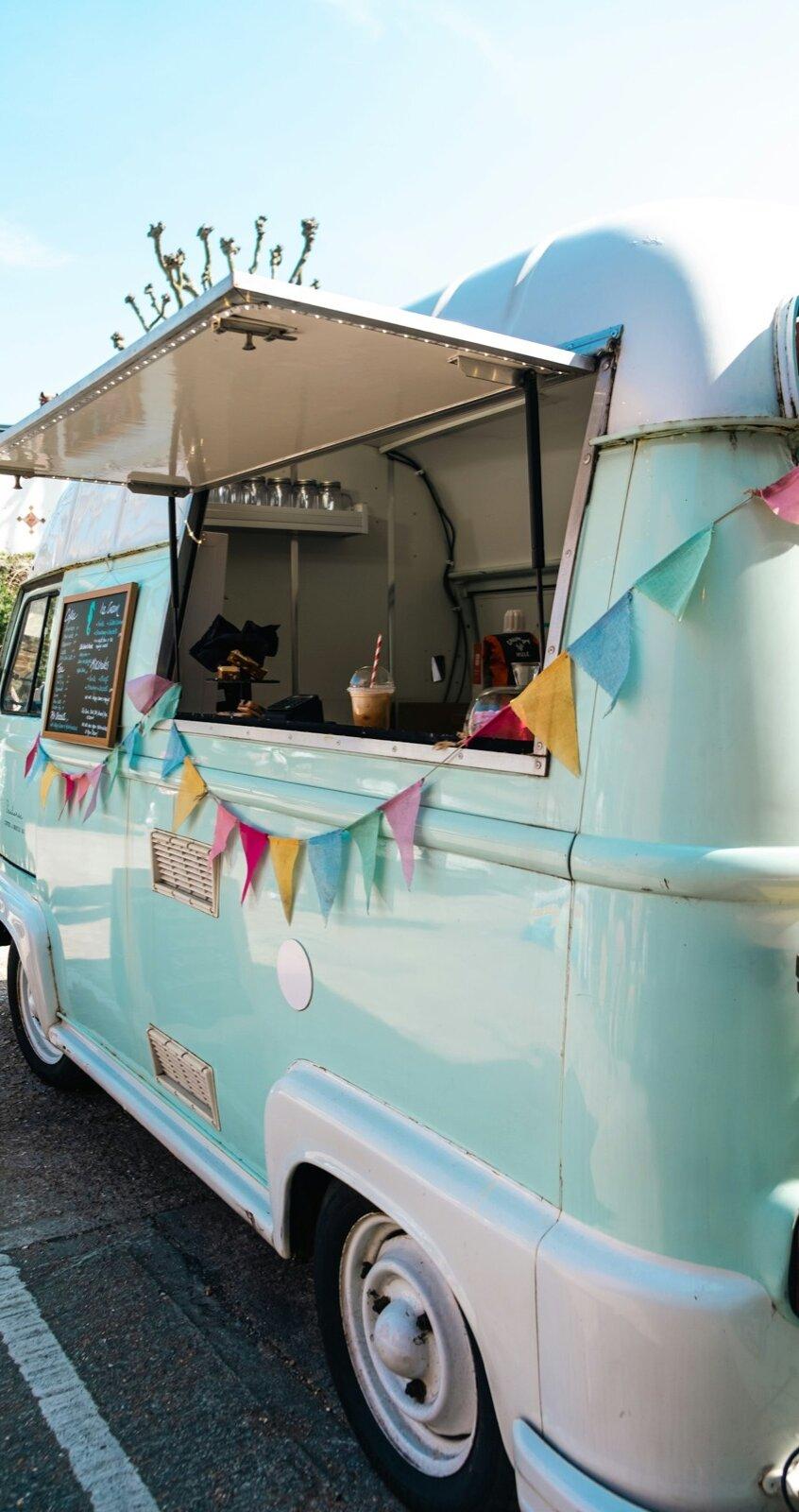
For food trucks and mobile stands, location is not a one-off decision but a weekly schedule. Typical options are weekly and farmers' markets, car parks of supermarkets, DIY stores or petrol stations, company premises with lunchtime trade and spots on public land. At markets, the municipality or a market operator allocates pitches by its own rules, often with product requirements and waiting lists. Public land needs a permit from the municipality, private land a contract with the owner. The permits behind this are explained in the start-up guides for Austria and Germany.
Mobile concepts have one big advantage: you can test locations. Stand at different spots for a few weeks, note the sales, weather and anything unusual each day, and keep only the pitches that pay their way. Even if you plan a fixed shop later, you learn a lot about demand in the area this way. Festivals, fairs and corporate events are a business of their own with different rules, see the guide on food trucks at events.
Site check: the checklist before you sign the lease
Go through these points for every location you are seriously considering and compare the results side by side. A location that fails on several points will be hard to rescue, even with great food. Once you have found your spot, speed at the lunchtime peak decides how much of the footfall you actually serve, see the guide on fast service at a snack bar.
Site check for snack bars and street food
- Footfall counted on at least three days during the planned selling hours
- Target group and footfall drivers within a few minutes' walk noted
- Competition including bakeries and supermarkets listed, gap in the offer found
- Sales calculated in three scenarios, rent affordable even in the cautious case
- Lease checked: term, indexation, key money, use as a snack bar permitted
- Technical side clarified: extraction, power, water, waste water, grease trap
- Visible from both directions, room for a queue, sign allowed
- Parking, stopping and deliveries possible nearby
- Asked the municipality whether this use and the permits are possible at this spot
- Online presence planned: Google profile, website with menu and location
A website for your snack bar and its location
Menu, opening hours, weekly location schedule and pre-orders on your own website: see for free what your snack bar could look like online.
A free preview of your venue website, designed by us.
Sources
- WKO Wien: Food trucks in Vienna (pitches, markets, additional premises)
- Gewerbeordnung 1994 (Austrian Trade Act), § 50 (trade activities outside business premises)
- Gewerbeordnung (German Trade Regulation Act), § 55a: activities without an itinerant trade card
- Gewerbeordnung (German Trade Regulation Act), § 67: weekly market
- Google Business Profile Help: Guidelines for representing your business