Key points at a glance
- Choose your roaster for taste, freshness, reliable delivery and training, not just the price per kilo. Taste several beans on your own machine.
- Espresso machines stand for craft and quality but need trained staff. Bean-to-cup machines are quick to learn and suit bakery cafés with changing teams.
- A free or loan machine is never free: you pay through the bean price and the minimum purchase. Read the term, back charges and notice period carefully.
- The cost per cup is made up of beans, milk, cup, water, cleaning and the machine. Work out every drink separately.
- Plant-based milk alternatives come with allergen rules (oats, soy, almond) and an EU rule on the name “milk”.
This post is general information and does not replace legal or tax advice. Rules change and some differ between federal states: check the details with your chamber of commerce (WKO) or IHK, the competent authority or your tax adviser.
Choosing the right roaster and beans
Most cafés do not buy their coffee from a wholesaler but directly from a roastery. There are good reasons for that: a fresh roast, one contact for set-up and problems, and often training and service from a single source. Whether you pick a small local roastery, a large hospitality roaster or a specialty coffee roastery depends on your concept. A Viennese-style coffee house serving Melange and Verlängerter needs a different bean from a coffee bar with filter coffee and light roasts.
What matters day to day is a house blend for espresso and milk drinks that tastes reliably good, even when the machine is not dialled in perfectly. Many guests drink cappuccino, latte or Melange, so the bean above all has to work with milk. Depending on your concept, add a decaf, a second bean for filter or a rotating guest coffee. Fewer coffees mean fewer grinders, less stock and fewer mistakes.
Questions for every roastery
- Where do the beans come from, and how transparent are origin and sourcing?
- How fresh is the delivery, and in which packs (1 kg, 250 g, valve bags)?
- How fast does new stock arrive, and is there a minimum order?
- Does the roastery offer cupping, on-site set-up and barista training?
- Who comes when the machine or grinder has a problem, and how quickly?
- How and when do prices change, and is there a price guarantee?
- May you sell the roastery's beans to guests, under your own label or theirs?
Taste two or three candidates on your own machine and with your own milk, ideally together with your team. A bean that tastes great in the roastery's showroom can be quite different with your water and your equipment. Ask for sample quantities for a few days of service, not just for one cup.
Espresso machine or bean-to-cup?
Choosing a machine is also a question of staff. A traditional espresso machine with portafilters makes the best espresso and real latte art when it is used well. But it needs people who can grind, tamp, steam milk and clean the machine every day. A bean-to-cup machine grinds, brews and froths at the push of a button. It can be explained in a few minutes and delivers consistent results, but rarely reaches the level of a well-run espresso machine.
| Criterion | Espresso machine | Bean-to-cup |
|---|---|---|
| Quality in the cup | Very high when used well | Consistent, usually solid |
| Training effort | High, ongoing | Low |
| Speed at peak times | High with two skilled people | Limited by the brewing unit and milk system |
| Impression for guests | Craft, barista at the counter | Practical, more self-service or bakery |
| Cleaning | Group heads, baskets and steam wand daily | Automatic programs, milk system daily |
| Suits | Café, coffee house, specialty coffee | Bakery café, hotel breakfast, small counter |
Size the machine for your peak, not your daily average. If you serve 80 drinks an hour on a Saturday morning, you need a different machine from a café with steady trade. Ask roasters and dealers for experience figures for your planned volume. What a new commercial machine roughly costs and what else belongs to the fit-out is covered in our guides Opening a café in Austria and Opening a café in Germany. A bakery café that combines a sales counter and seating will find matching tips in the guide to the bakery café.
Grinder and water filter: often underestimated
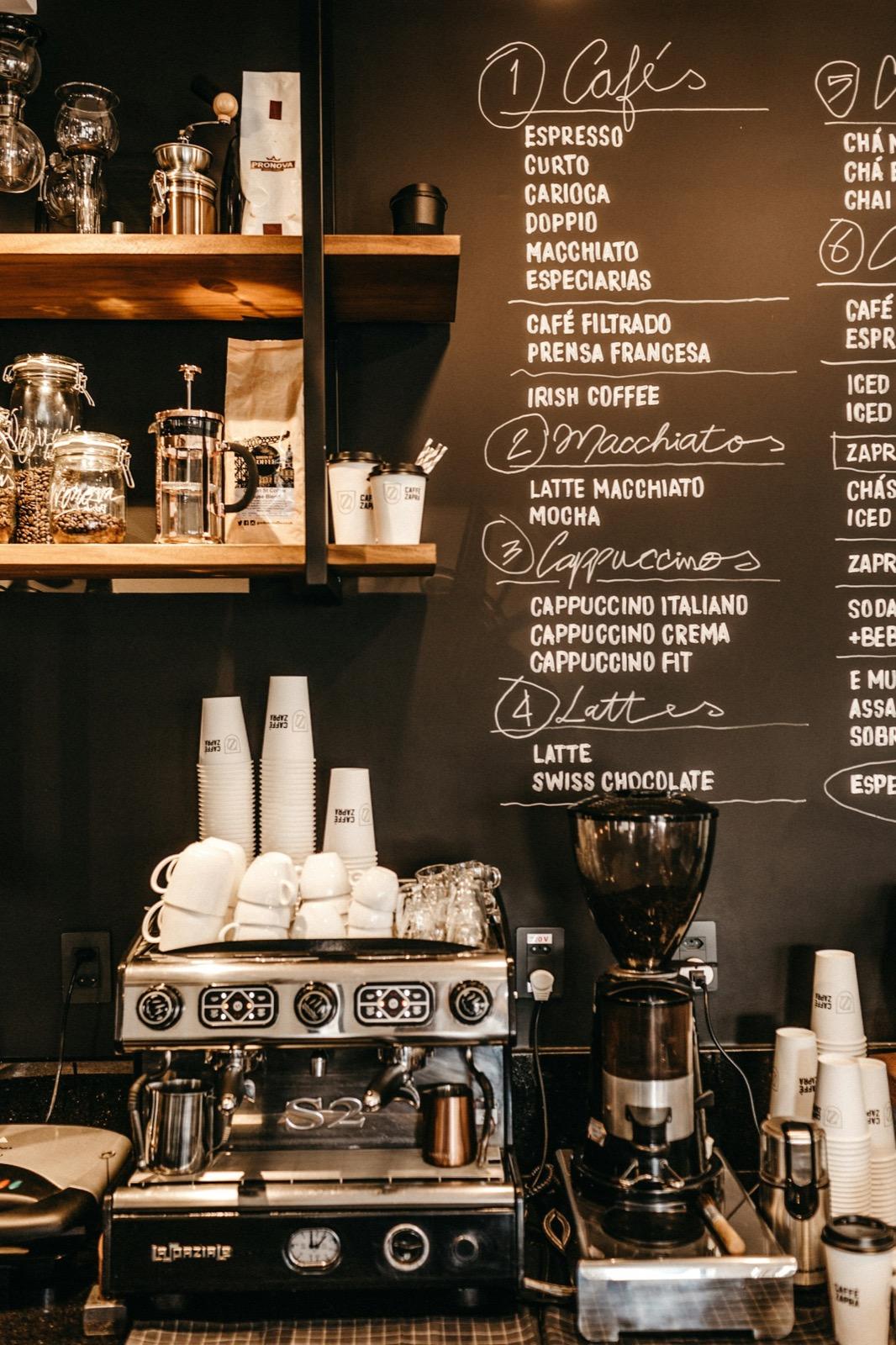
Many baristas say the grinder matters more than the machine. It decides how evenly the coffee is ground and how precisely you hit the dose. For espresso you need a commercial grinder with a finely adjustable grind size, ideally grinding on demand straight into the portafilter, so no ground coffee goes stale in the hopper. For decaf or a second bean, a second grinder pays off, otherwise you are constantly readjusting.
Coffee is mostly water. If it is very hard, limescale builds up in the boiler and pipes and leads to expensive repairs. Water that is too soft or heavily treated tastes flat and can damage parts. Your local water supplier can tell you how hard your tap water is. The roaster or technician then sets up the right filter. Change the cartridge after the stated number of litres, not by feel, and keep a written record. Check in the contract or warranty terms whether water treatment is required.
Free machine and leasing: check the purchase commitment
Many roasteries offer the machine and grinder on loan, for a small rent or on lease if you buy their beans in return. When you are starting out, that is tempting: the most expensive purchase disappears. You still pay, just differently: through a higher price per kilo, a minimum purchase per month or year and a fixed term. That can be fair, especially if service and training are included. But it can become expensive if you sell less than planned or want to switch roasters.
How to get it right
- Set the minimum purchase to match your cautious plan, not your best week
- Compare the price per kilo with and without a machine and project it over the whole term
- Clarify what happens if you fall short of the quantity (back charge, rent, contractual penalty)
- Put service, response time, replacement machine and maintenance in writing
- Read the notice period, renewal and return of equipment before you sign
Better not
- Signing a long contract before you have tasted the beans
- Relying on verbal promises about prices or service
- Overlooking that the contract renews automatically
- Assuming that “free” means nothing in return
A simple comparison helps: multiply the extra cost per kilo by your annual volume and by the term, and set it against the purchase price plus maintenance of your own machine. With leasing, add the instalments; with a purchased machine, the depreciation. If a contract has a long commitment or penalties, have it checked by your chamber of commerce (WKO in Austria, IHK in Germany), a lawyer or your tax adviser.
Calculating the cost per cup properly
Coffee usually has a low cost of goods, which makes it one of the most profitable products in a café. But that only holds if you know every component. The starting point is the dose: a double espresso often uses around 16 to 18 grams, a single about half that. Divide the price per kilo by the number of portions per kilo, and factor in the waste from dialling in the grinder in the morning.
| Component | Assumption | Cappuccino |
|---|---|---|
| Coffee | 18 g per drink, €25 per kg, 5 % waste | approx. €0.47 |
| Milk | 150 ml, €1.20 per litre, leftovers included | approx. €0.20 |
| Sugar, biscuit, napkin | Flat rate | approx. €0.05 |
| Cup and lid (takeaway only) | Depends on material | extra |
| Water, filter, cleaning agents | Spread over drinks per month | a few cents |
| Total cost of goods | excluding machine, staff, rent | approx. €0.75 plus cup |
The cost of goods is only part of the picture. Staff, rent, energy and the machine itself often cost much more per cup than beans and milk. A loan machine with a higher price per kilo sits in the “coffee” line; a purchased machine sits in your fixed costs. How many guests your café needs per day to cover these fixed costs is shown by the free break-even calculator for cafés. How to bring cost of goods and fixed costs together for the whole business is explained in our guide to costing in hospitality. For the selling price, the price calculator works from cost of goods via a target share, including VAT, to a rounded menu price. When and by how much to raise existing prices and how to explain it to guests is covered in the guide raising coffee prices.
From cost of goods to menu price
Enter your cost per cup and get a rounded-up selling price based on your target share and VAT.
Barista training and consistent quality
The best bean is useless if every shift works differently. Good roasteries train your team at the opening, and many offer courses for beginners and advanced baristas. Schedule training before you open and repeat it when new staff join. Write down the key values as a recipe and hang it next to the machine.
Set the recipe
Agree dose, yield in the cup and extraction time for each drink together with the roastery.
Dial in every morning
Check the grind size and fine-tune with a scale before the first guests arrive.
Practise steaming milk
Standardise temperature and foam for cappuccino, latte and Melange, including plant-based drinks.
Clean daily
Clean group heads, baskets, steam wand and milk system to a schedule and tick them off.
Taste regularly
Taste together once a week and readjust for every new roast batch.
Milk alternatives: choice, allergens and naming
Oat, soy, almond or coconut: plant-based alternatives are standard in almost every café. Choose barista versions that steam well and do not curdle in coffee, and test them with your house blend. One or two kinds are usually enough. Factor in the higher purchase price, either as a surcharge or in the base price.
- Allergens: oats count as cereals containing gluten, and soy and almonds (tree nuts) must be declared too. Lactose-free milk is still milk under the allergen rules.
- Labelling: allergens in drinks belong on the menu or at the counter just like those in cakes. Our allergen guides for Austria and Germany explain how, and you can create a legend with the allergen legend.
- Naming: under EU law the name “milk” is generally reserved for products from animal milk, with a few exceptions such as coconut milk. On the menu, terms like “oat drink” or “with oat” are on the safe side.
- Cross-contact: a separate milk jug for plant-based drinks and wiping the steam wand reduce residues.
Preview your café website
See for free how your website could look with your drinks menu, roastery and opening hours.
A free preview of your venue website, designed by us.