Key points at a glance
- Menu or buffet depends on seats, kitchen and guest numbers: a small menu usually suits weekdays, a brunch with fixed time slots suits the weekend.
- Cost your offer per plate or per guest, including food cost, waste, staff and length of stay. With a buffet, leftovers and refills decide your profit.
- A weekend brunch with bookings and two sittings makes the peak predictable; confirmations and reminders reduce no-shows.
- Workflows and staffing determine quality: prep the day before, clear stations, chilling at the buffet and allergen information for every dish.
- Online, what counts is a breakfast menu as text, a well-kept Google profile with correct opening hours and good photos, so you appear for “breakfast near me”.
This post is general information and does not replace legal or tax advice. Rules change and some differ between federal states: check the details with your chamber of commerce (WKO) or IHK, the competent authority or your tax adviser.
Breakfast, brunch or both?
Breakfast and brunch sound similar, but they work differently in practice. Breakfast is usually a weekday offer: guests come before work, with children after the school run or as a group of retirees mid-morning. They tend to stay briefly and order à la carte. Brunch is a weekend or holiday event: groups, families and friends come on purpose, stay for a long time and expect a wider choice, often savoury and sweet dishes and a glass of sparkling wine.
Before you plan your menu and prices, answer three questions: How many seats do you have and how often can you fill them in the morning? What can your kitchen handle: just a toaster and an espresso machine, or a stove, eggs and hot dishes too? And who are your guests: passers-by, nearby offices, families, tourists? A bakery café with a counter has different options from a breakfast place with a full kitchen. What the trade rules say when a bakery offers seating and breakfast is covered in the guide Bakery with a café area.
| Weekday breakfast | Weekend brunch | |
|---|---|---|
| Guests | Individuals, couples, commuters, regulars | Groups, families, circles of friends |
| Length of stay | Rather short | Long, often two hours or more |
| Format | Small menu, breakfast plates | Buffet, tiered stand or brunch menu |
| Planning | Walk-ins, hardly any bookings | Bookings with time slots |
| Price | Per dish | Often a set price per person |
Menu, buffet or tiered stand
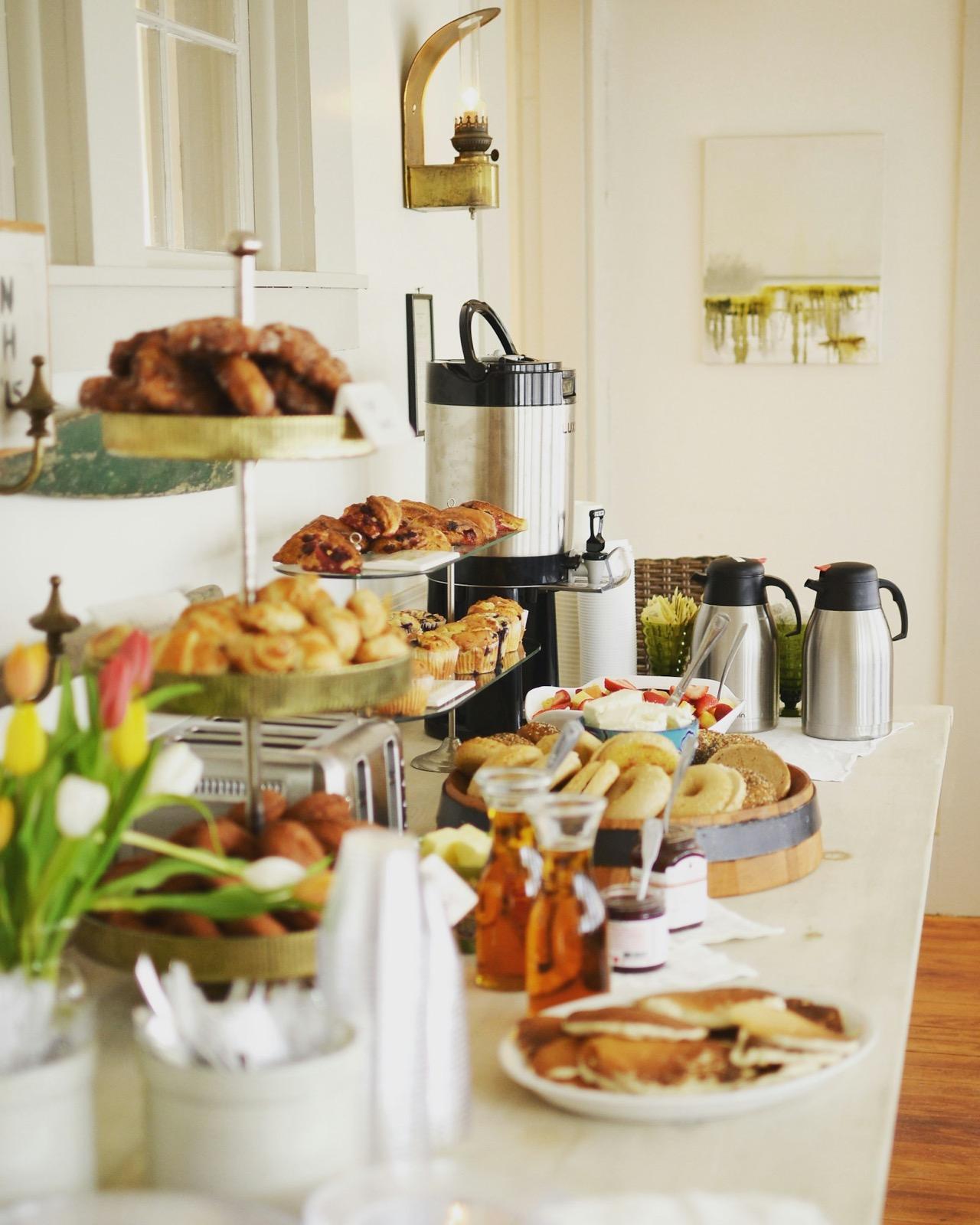
The most important decision is the format. A breakfast menu with five to ten items is easy to cost, creates little waste and works even with few guests. In return, it needs more hands in the kitchen at peak times, because every plate is assembled individually. A buffet moves the work forward: preparation and refilling instead of orders and plating. It pays off above a certain number of guests, because otherwise you throw too much away. A hybrid is the brunch tiered stand or brunch board: a fixed set-up per table, plus a hot dish of the guest's choice. It looks generous, is as predictable as a menu and saves the space a buffet would need.
| Format | Strengths | Weaknesses | Suits |
|---|---|---|---|
| Breakfast menu | Little waste, clear prices, works on quiet days | Peaks strain the kitchen, more tickets | Weekdays, small cafés, bakery cafés |
| Buffet | Wide choice, relieves service, set price | Leftovers, space needed, hygiene effort | Many guests, weekends, hotels and larger cafés |
| Tiered stand or board per table | Predictable, feels special, great for photos | More crockery, plating takes time | Brunch with bookings, small kitchens |
| Menu plus small buffet | Sweets and fruit at the buffet, hot dishes à la carte | Two workflows at once | Cafés with a well-practised team |
How to get it right
- A small menu with clear classics and one seasonal plate
- Plan dishes so they are built from a few basic components
- Include vegetarian and vegan options as standard
- Use small bowls at the buffet and refill more often
Better not
- Twenty breakfast variations that all need their own ingredients
- Setting up a buffet for ten guests
- Large platters that look unappetising after an hour
- Unlimited drinks in a set price without costing them
Costing: per plate and per guest
With a menu, you cost each plate like any other dish: a recipe with weights, purchase prices, the resulting food cost per portion, then the mark-up for staff, rent, energy and profit. Include the small things that are easily forgotten: butter, jam, garnish, syrup, oat milk, napkins. How recipes, food cost and contribution margin fit together is explained in detail in the guide to menu costing. The price calculator works out the selling price from food cost, target percentage and VAT for you.
With a buffet, you calculate per guest. For a few weeks, record what you buy, what is left over and how many guests came. This gives you the actual food cost per person including waste. Length of stay is a cost factor of its own: a table that is occupied for three hours can only be sold once per morning. That is exactly why many cafés work with fixed time slots.
Record food cost
Note purchases per brunch day, weigh or estimate leftovers at the end and divide by the number of guests.
Separate drinks
Cost coffee, juices and sparkling wine separately. Clearly limit included drinks, for example one hot drink and one juice. The drinks price calculator works out the price per cup or glass.
Spread staff and fixed costs
Include hours for preparation, service and clearing up, plus a share of rent and energy for the morning.
Set rules for children and groups
Stagger children's prices by age and set a separate offer with a deposit for large groups.
Review after four weeks
Compare actual food cost and occupancy with your plan and adjust price, quantity or choice.
Weekend brunch with bookings
On Saturdays and Sundays, most guests arrive within a narrow window. Without bookings, you get queues at the door, half-empty tables at nine and an overstretched team at eleven. With fixed time slots, for example a first sitting early in the morning and a second from midday, you spread guests out and can sell each table twice. State the duration openly when guests book, for example “Your table is reserved for two hours”. Most guests accept this if they know in advance.
Still keep a few seats free for walk-ins, especially at the counter or on the terrace. For groups of around eight or more, a separate enquiry with a set menu or a deposit is worthwhile. Which booking channels exist, what to consider with deposits and cancellation fees and how to avoid no-shows is covered in the guide to online table reservations.
Weekend brunch checklist
- Set time slots and mention them when guests book
- Link online booking on your website and Google profile
- Send confirmations and a reminder the day before automatically
- Keep a quota free for walk-ins and counter seats
- Group offer with a deposit and a deadline for final numbers
- Open bookings for Easter, Mother's Day and Christmas early
- Keep a waiting list for fully booked dates
Workflows, hygiene and allergens
A good brunch starts the day before. Spreads, muesli, chopped vegetables, batters and dressings can be prepared, labelled and stored chilled. The recipe scaler for buffets and brunch brings the quantities in line with the number of booked guests. In the morning, only the things that must be fresh remain: eggs, baking off bread, cutting fruit, coffee. For every dish, decide who prepares it, how it is plated and how long it takes. Photos of the finished plates at each station help every plate look the same, even with temporary staff.
At the buffet, the general hygiene rules for food businesses apply with particular strictness: chilled items such as salmon, cold cuts, cheese and yoghurt belong on cooling plates or ice, hot dishes in warming containers. Refill into fresh bowls instead of topping up, provide serving utensils for every dish and use a sneeze guard to protect open food. Decide how long dishes may stay on the buffet at most, and record temperatures in your food safety self-checks.
At breakfast too, you have to inform guests about the 14 major allergens, for example with small labels for each dish at the buffet. The rules are the same across the EU, but implementation differs in the details. See the allergen guide for Austria or Germany.

Allergen legend for menu and buffet
Create a clear, printable legend of the 14 major allergens for your breakfast menu, buffet labels and counter.
Staff and shifts in the morning
Breakfast means early shifts. Plan the prep before opening realistically and divide work by station rather than having people who do “a bit of everything”. At weekends, a clear division of roles has proven itself: one person on the espresso machine, one or two in the kitchen for eggs and hot dishes, one for the buffet and clearing tables, and one front of house for greeting guests, tables and the till. With tiered stands or boards, add someone for plating.
- Fixed brunch teams: people who work every weekend know the workflows and the regulars.
- Train temporary staff: station cards with recipes and photos, a trial shift during the week.
- Plan breaks and rest periods: after a late evening shift, the next one cannot start arbitrarily early. The exact rules are in working time law and the collective agreement (Kollektivvertrag in Austria, Tarifvertrag in Germany); WKO, IHK or DEHOGA can advise.
- Staff to demand: the previous day's bookings show how many hands you need.
Getting found online: “breakfast near me”
People who want to go out for breakfast usually search at short notice on their phone: “breakfast near me”, “brunch Vienna”, “breakfast Leipzig Südvorstadt”, “vegan breakfast”. Google shows venues that match the search, are nearby and are well known. For your café to be among them, you need a dedicated breakfast or brunch page on your website, with the menu as text, times, prices, a booking button and your neighbourhood mentioned in the text. Google can hardly read a menu as a photo or PDF. More on this in the guide to local SEO.
In your Google Business Profile, the opening hours should be right for the morning too, including special hours on public holidays. Choose fitting categories, upload current photos of breakfast and brunch and link your menu and bookings. A post on your profile or on Instagram announcing the new brunch offer for the weekend also helps.
Breakfast online checklist
- Dedicated page for breakfast and brunch with the location in the page title
- Breakfast menu as text with prices and vegetarian or vegan options
- Brunch times, time slots and set price clearly visible
- Booking button on your website and in your Google profile
- Opening hours and holidays identical everywhere
- Bright, genuine photos of plates, buffet and dining room
- Reply to reviews, especially about waiting times and freshness
Your café website with a breakfast menu
See in a free preview how your website could look with a breakfast and brunch page, a menu as text and bookings.
A free preview of your venue website, designed by us.
Sources
- Google Business Profile Help: Tips to improve your local ranking on Google
- Google Search Central: Local business structured data
- WKO: Allergen labelling of food in hospitality (German)
- Lebensmittelinformations-Durchführungsverordnung (LMIDV), German food information implementing regulation
- Regulation (EC) No 852/2004 on the hygiene of foodstuffs